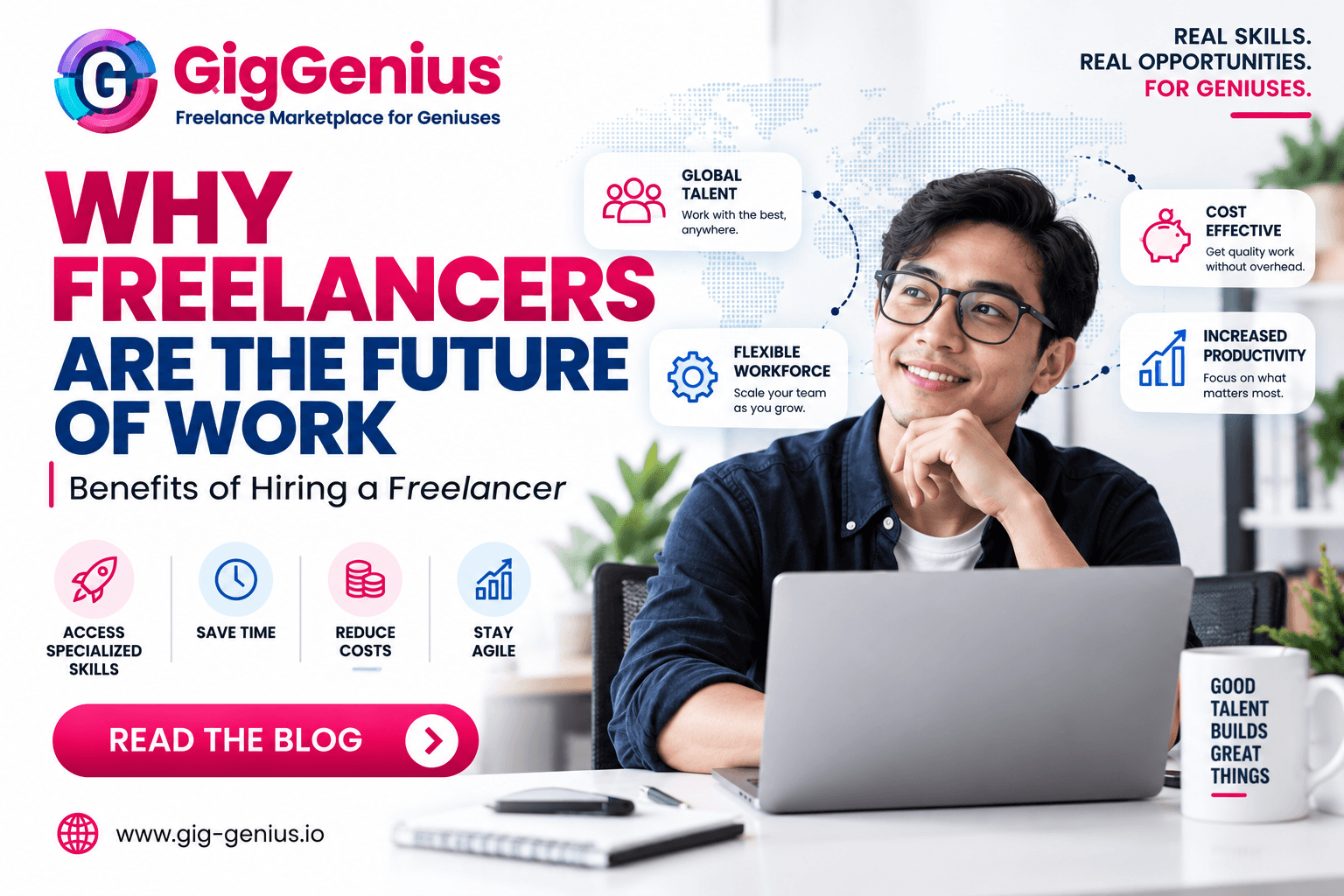
The world of work is changing, and Gen Z is leading the charge. This generation, known for their digital fluency, entrepreneurial spirit, and passion for purpose-driven work, is reshaping the traditional employment landscape. And at the heart of this shift is the rise of freelancing.
The way businesses build their teams is changing.
Freelancing is no longer limited to occasional side projects or temporary administrative work. Independent professionals now work across software development, marketing, design, consulting, finance, AI, operations, and other specialized fields.
The numbers reflect that shift. Upwork's 2026 Future Workforce Index, based on a study of 2,400 skilled U.S. knowledge workers, found that 38% were freelancing—up from 28% the previous year. Meanwhile, 58% of full-time employees surveyed said they were considering freelancing to gain better access to professional opportunities.
The independent workforce is also becoming economically significant. MBO Partners reported 72.9 million independent workers in the U.S. in 2025, with 5.6 million earning more than $100,000 annually. It also found that 32% of independent workers serve clients internationally.
Globally, the shift is even broader. The World Bank has estimated that the gig economy may account for up to 12% of the global labor market, with demand for online gig work growing particularly quickly in developing economies.
For businesses, these numbers point to something bigger than a change in how people prefer to work.
They represent a change in how companies can access talent.
Why Businesses Are Hiring More Freelancers
Traditional employment remains essential for many positions, but not every business requirement calls for another permanent employee.
A company may need a developer for a website rebuild, a CRM specialist for an automation project, a graphic designer for a campaign, a virtual assistant for ongoing administrative support, or a marketing professional to launch a new service.
Freelancers allow businesses to bring in the expertise they need when they need it, without necessarily expanding their permanent workforce.
1. Access Specialized Skills
One of the strongest reasons to hire freelancers is access to expertise.
Instead of expecting one employee to handle several unrelated responsibilities, businesses can hire professionals whose experience closely matches a particular project.
The freelance workforce increasingly includes highly skilled professionals. Upwork's research found freelancers participating heavily in areas such as software development, machine learning, sustainability, creative work, marketing, and consulting.
For businesses, that means the question can shift from:
“Who can we hire locally to do everything?”
to:
“Who has the right expertise to solve this particular problem?”
2. Build a More Flexible Workforce
Business needs fluctuate.
A company might require additional support during a product launch, holiday season, expansion, website development project, or temporary increase in customer demand.
Hiring freelancers allows businesses to increase or reduce resources according to actual workload.
This can be particularly valuable for startups and small businesses that need professional expertise but aren't ready to build a large permanent team.
3. Control Costs Without Simply Looking for the More Affordable Labor
The financial advantage of freelancing shouldn't be interpreted as “freelancers are more affordable employees.”
That approach often leads businesses to hire solely based on the lowest rate rather than capability.
The real advantage is that companies can allocate money toward the specific expertise, hours, or deliverables they actually need rather than automatically creating another full-time position.
For example, a business that needs 20 hours of specialized CRM work doesn't necessarily need a full-time CRM employee.
It needs 20 hours of excellent CRM work.
That distinction can make workforce spending much more intentional.
4. Access Talent Beyond Geographic Boundaries
Remote work and digital freelance platforms have dramatically expanded the available talent pool.
Businesses are no longer restricted to professionals who happen to live within commuting distance of an office.
A company in the United States might work with a developer in the Philippines, a designer in Europe, a consultant in Australia, and a marketing specialist in another U.S. state.
MBO Partners' 2025 research found that 32% of independent workers were serving global clients, illustrating how international independent work has become increasingly established.
For businesses, geography becomes less important than skills, communication, reliability, compatibility, and results.
5. Bring New Perspectives Into the Business
Freelancers frequently work with different companies, industries, technologies, and workflows.
That exposure can give experienced independent professionals a broader perspective on how problems can be solved.
A freelancer may have already encountered a challenge similar to yours with another business and can bring lessons, processes, or ideas that an internal team hasn't considered. External expertise can therefore complement—not replace—the knowledge of an existing team.
6. Increase Agility
Businesses sometimes lose opportunities because hiring takes longer than the opportunity itself.
A new campaign may need to launch next month. A website problem might need fixing this week. A new client could suddenly increase the team's workload.
Freelancers can give organizations another way to respond to these situations without redesigning their entire organizational structure.
The result is a workforce that can combine:
Permanent employees + specialized freelancers + technology
depending on what each situation requires.
Freelancers Aren't Automatically Better But Hiring the Right Freelancer Matters
This is an important distinction.
The growth of freelancing doesn't mean that every freelancer is highly skilled, reliable, or appropriate for every project—just as every traditional employee isn't automatically the right hire.
Businesses still need proper hiring practices.
Look at relevant experience, portfolios, communication skills, references or reviews, technical capabilities, availability, professionalism, and whether the freelancer actually understands the project's requirements.
Price should be considered alongside competence and value, not treated as the only hiring criterion.
A cheap hire who requires extensive corrections can ultimately cost considerably more in lost time, missed deadlines, and rework.
The Future of Work Is About Access to the Right Talent
The future of work probably isn't a world where freelancers completely replace employees.
It's more likely to be one where businesses become much more flexible about how they assemble talent.
The 2026 data already shows skilled freelancing expanding rapidly, while independent professionals are also adapting quickly to technologies such as AI. Upwork found that freelancers performing AI-related work on its marketplace earned 34% more per hour than freelancers not incorporating AI, while more complex AI-augmented professional services experienced significant growth.
For business owners, the opportunity isn't simply to “hire freelancers.”
It's to build a smarter talent strategy:
Hire permanent people where permanence makes sense. Bring in specialized freelancers where flexibility and expertise make sense. Use technology where automation makes sense.
Let GigGenius help you find the perfect freelancers to fuel your business's growth and innovation. Join GigGenius today and discover a world of possibilities!